Biotope / Habitat
- From the lower shore to over 1,000 m, mostly between 5 and 100 m.
- Mainly soft bottoms (sand, muddy sand, gravel) where it can bury, but also on rock and wrecks.
- Cold to cool-temperate waters.
- Carnivore, mainly a scavenger: its highly sensitive osphradium detects dead fish, molluscs and crustaceans from far away.
- Also takes small live bivalves, wedging their valves open with its shell lip and inserting its proboscis.
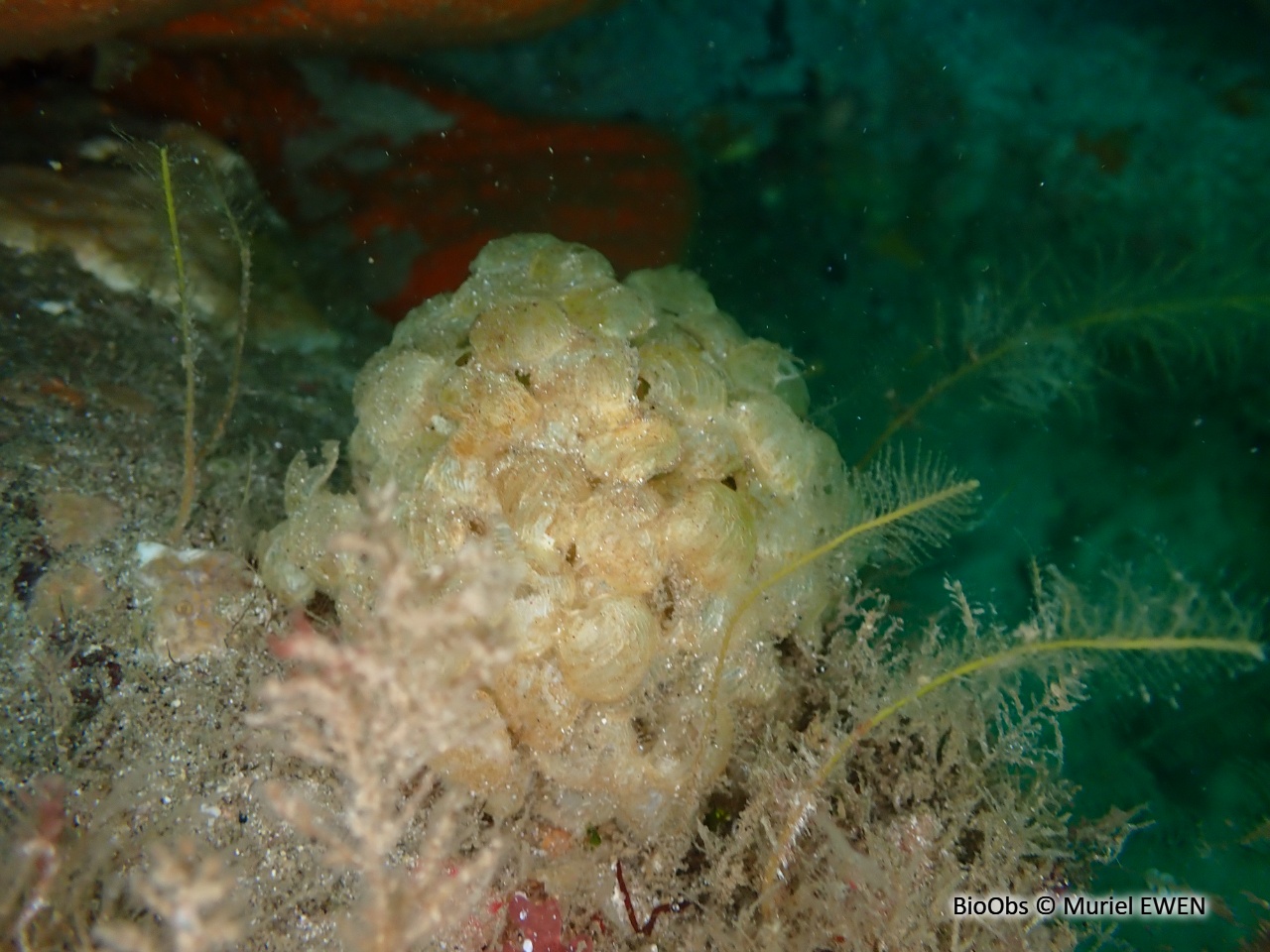
- Its spongy, yellowish egg masses often wash up on beaches. Sailors once used them to wash their hands, hence the name "sea wash ball".
Distribution
- Widespread across the North Atlantic.
- East: from the Arctic and Barents Sea to the Bay of Biscay, including the British Isles, North Sea and Baltic.
- West: from Greenland to New Jersey.
- Overall range stable, though some local populations suffer from fishing pressure.
Possible confusions
- Neptunea antiqua Red whelk: larger, with smooth whorls lacking wavy ribs and a longer siphonal canal.
- Colus gracilis: much narrower, spindle-shaped shell with a long straight canal and almost no axial ribs.
- Netted dog whelk Nassarius reticulatus: much smaller (3–4 cm max), regular criss-cross sculpture, spread callus around the aperture, two tail filaments on the foot.
- Trophonopsis muricata: very small (1–2 cm), with sharp, spiny axial blades.