How it works
Contributing is easy
No diving level required, no need to be a biologist. You observe, you record what you saw in your logbook — the BioObs team and the community help you with the rest.
The dive logbook
Your survey, tab by tab
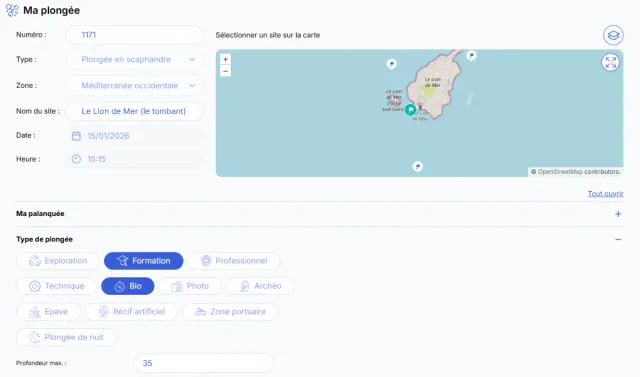
Describe your outing
My diveDate, duration, depth, setting of the outing… and above all the site. Pick it from more than 3,000 sites already described, or drop a pin on the map if it doesn't exist yet.
The site sets the geographic area, and therefore the list of species suggested to you in the next step.
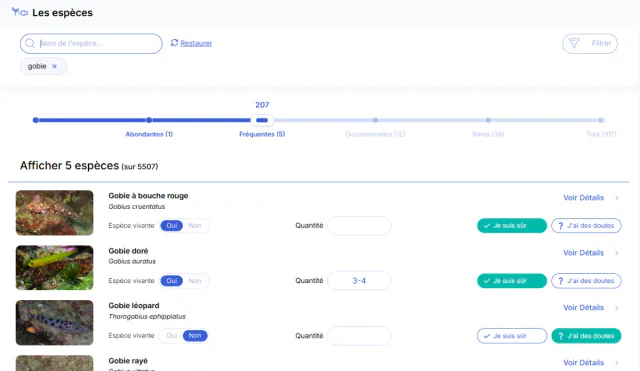
Identify the species
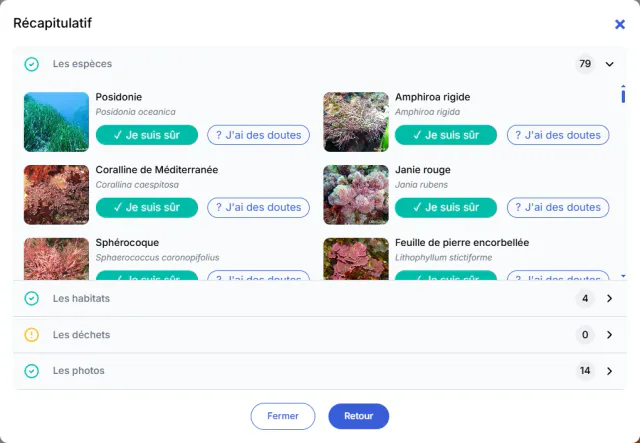
SpeciesBioObs shows you the species of your area, from the most abundant to the rarest. Filter by group or by citizen science programme, or search for a name directly.
For each species seen, a single gesture: “I'm sure” or “I have doubts”. You can specify the quantity and whether the individual was alive.
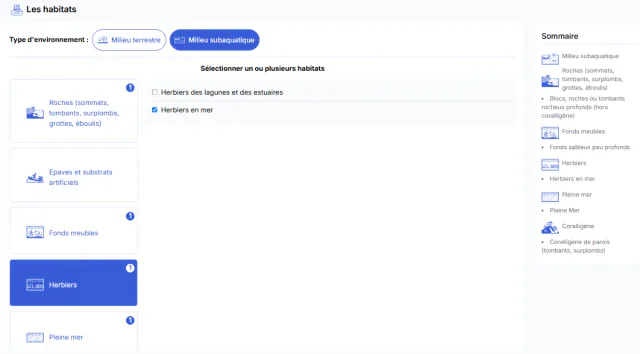
Record habitats and litter
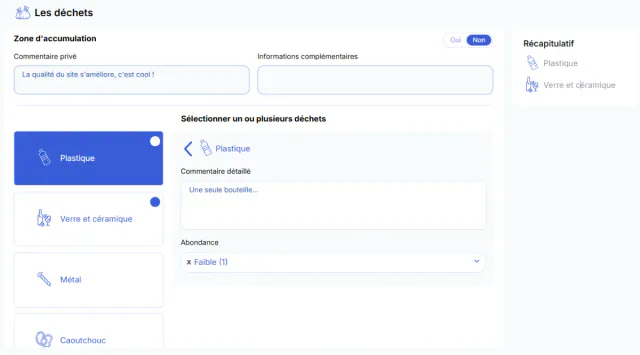
OptionalHabitatsRubbishesSeagrass, rock, sand, drop-off… the environments you passed through give meaning to your observations. And the litter you came across is valuable data for monitoring the environment.
For each item of litter, give its abundance and a detailed comment.
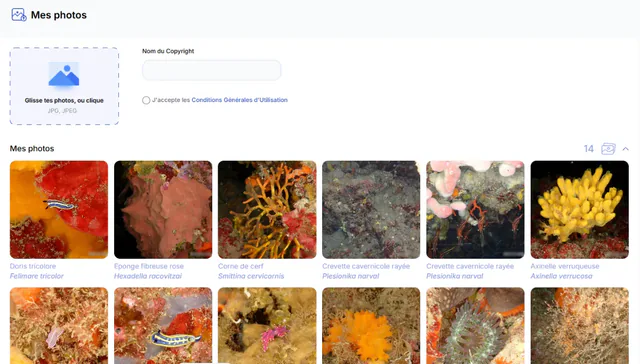
Add your photos
OptionalMy photosDrop in your photos, link each one to the species observed and choose your cover photo. A photo, even an imperfect one, makes validation much easier.
Your photos stay credited to your name (copyright). The best ones may illustrate the species sheets.
Review and close
Summary and validationThe summary covers your whole survey and points out anything you may have forgotten to identify. You can still edit it, save it as a draft, or close it.
Once closed, your survey goes to validation.
Were you diving with a buddy?
Add your dive buddies to the survey. If they don't have an account yet, they receive an email invitation so they can find this survey in their own logbook once they have signed up.
Where to observe
Underwater, on foot and in the lab
Diving
The heart of the observatory: your underwater outings, whatever your practice.
- Scuba diving
- Freediving / snorkelling
- Snorkel trail
- Boat
On foot
NewNo equipment needed: a low tide or a walk along the water's edge is enough.
- Foreshore
- Strandline
- Riverbank
In the lab
NewSamples observed under a magnifying glass or a microscope: the invisible world of plankton enters the inventory.
- Lab / Plankton
Identification
Doubt is a contribution
I'm sure
You recognise the species without hesitation.
I have doubts
You're torn between two species, or the photo is blurry. The observation is kept, and flagged as doubtful.
This badge invites you to contribute further: completing a species sheet, adding a missing piece of information… And if you're unsure about an observation, the “Discussion” tab of your survey puts you in touch with the validators.
Validation
The life of a survey
Draft
You complete your survey at your own pace.
Closed
You have reviewed it and sent it.
Under validation
Two validators check it, correct it if needed and talk it over with you.
Validated
Your observations join the public inventory.
What gets checked
The species, habitats and litter identified, the photos, and the position of the site.
A conversation, not a verdict
Every correction is visible in your survey, and the discussion with the validators stays open.
Editing afterwards
A validated survey is locked. You can unlock it to correct it: it will then go through validation again.
Validation times vary a lot with the time of year: they get longer at the height of the diving season, when surveys pour in. Thank you for your patience!
What it's for
What happens to your observations
Report by area
Sites, species and 10-year trends around the point of your choice — downloadable lists.
Explore an areaDistribution map
Where a species' validated observations were made, site by site.
Choose a speciesRemarkable species
Remarkable species, and those seen for the first time on BioObs.
Coming soonMonitoring programmes
ALIEN networks, SOS Grande nacre, SOS Mortality and Climate Change.
Our activities (in French)
Towards national knowledge
Your data go first to the INPN
Validated observations are sent first and foremost to the French National Inventory of Natural Heritage (INPN), run by the French National Museum of Natural History. They enrich the national knowledge of biodiversity, in support of research and the protection of the environment.
A long-standing partnership with the French Biodiversity Agency (OFB) and the INPN, which ensures that every observation counts well beyond BioObs.
Going further
Other ways to contribute
Complete a species sheet
Some observed species don't have a description yet. Write one: it will be reviewed by several validators before publication.
Sheets to completeIllustrate the sheets
Your best photos may be chosen to illustrate the species sheets, always credited to your name.
Species photos (in French)Join the association
Become a member of Les Amis de BioObs, or contact your regional coordinator to help run the observatory.
Contact us
Frequently asked questions
You may be wondering…
Is BioObs free?
Yes. Creating an account and using BioObs costs nothing. The observatory is run by the association Les Amis de BioObs.
Do I need a diving level, or to be a biologist?
Neither. A snorkel trail or an outing on the foreshore is just as useful as a deep dive, and “I have doubts” exists precisely for the species you can't recognise for sure.
Can I record an old dive?
Yes. Enter the actual date of the outing, even if it goes back several years — while staying true to your notes and photos.
I don't have a photo — is that a problem?
No. A photo makes validation easier, but an observation without a picture is still accepted. As for the format, BioObs accepts JPG photos; you need to accept the photo terms of use before your first upload.
My buddy doesn't have an account — what should I do?
Add them to the survey: they will receive an email invitation and will find this survey in their logbook once they have signed up.
Can I edit a survey that has already been validated?
Yes, by unlocking it from your logbook. It will then have to be validated again by the BioObs team.
Who sees my observations?
Once validated, they feed the observatory's public reports and maps, and are sent first and foremost to the INPN (French National Museum of Natural History). Your private comments stay private.
How do I receive the monthly newsletter?
You manage your subscription from “My preferences”, in your personal area: so you need a BioObs account. An email address alone is not enough. The newsletter is written in French.
Another question? Read the FAQ (in French) or write to us.
Ready to record your first observation?
Create your account (it's free): your next outing could be in your logbook tonight.