Possible confusions
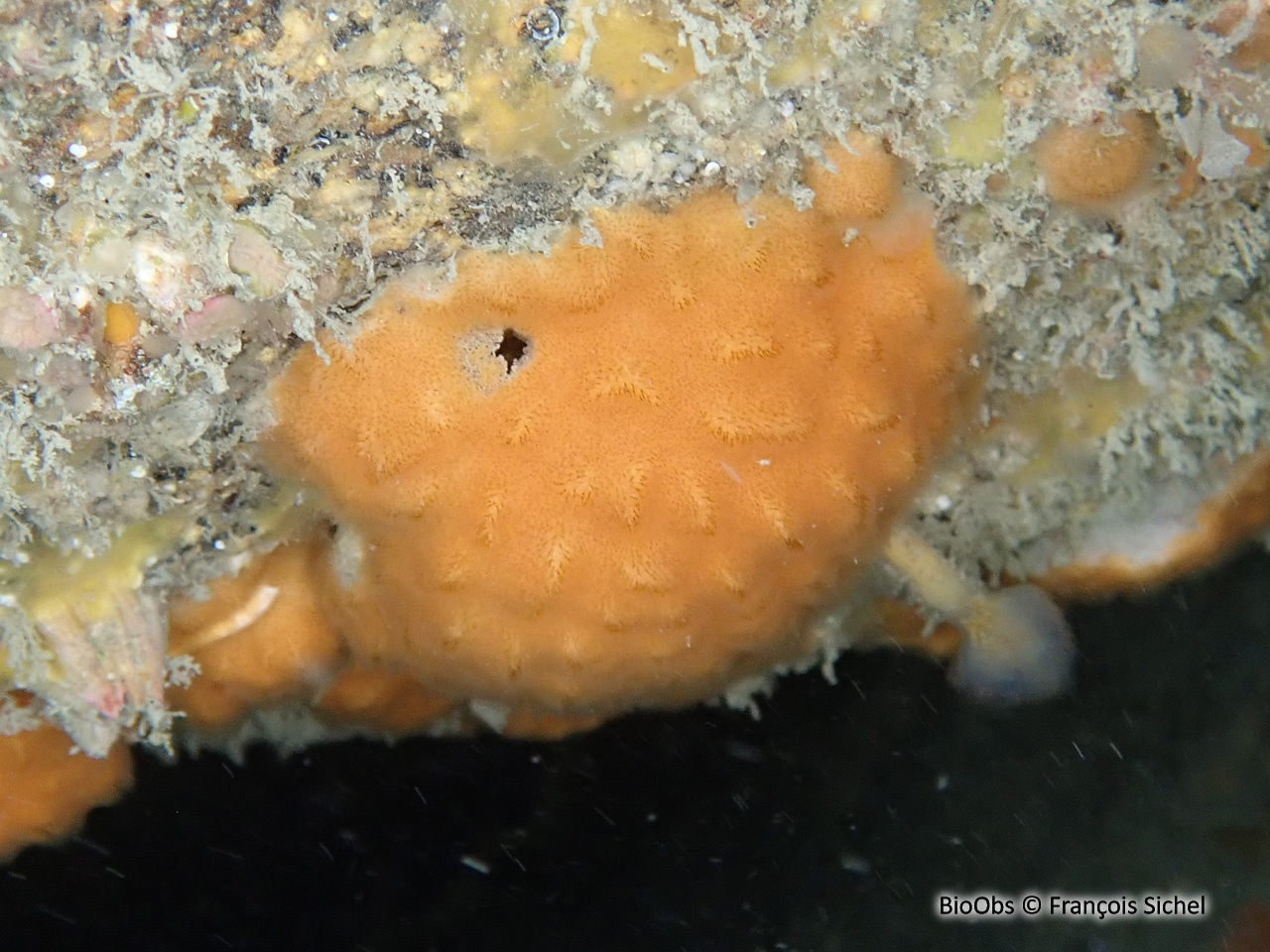
Diaphorodoris luteocincta: This closely related species is immediately distinguished by the presence of a large red, purplish, or brown central patch on its back, whereas Diaphorodoris alba has an entirely white back.
Cadlina laevis: This nudibranch also displays a translucent white body with a yellow border but reaches a much larger size (up to 30 mm) and features a mantle covered with flat yellowish glands rather than erect conical papillae.
Crimora papillata: although it exhibits white and yellow coloration, its dorsal papillae and rhinophores are bifid or branched, unlike the simple conical papillae of D. alba.
Goniodoris nodosa: this whitish species has a distinct median dorsal keel and reduced marginal papillae, while lacking the bright yellow marginal border.
Biotope / Habitat
Diaphorodoris alba mainly inhabits the infralittoral zone, from the surface under dark overhangs down to about 55 meters deep.
This species is found on sheltered to moderately wave-exposed rocky bottoms. It is frequently encountered in crevices, cavities, under overturned stones, or on kelp holdfasts.
Its presence is generally seasonal, with an observation peak between late spring and autumn, coinciding with the growth of its preferred prey.
It is a benthic species with a cryptic lifestyle, moving slowly in search of food. Its diet is strictly carnivorous and specialized: it feeds exclusively on encrusting calcareous bryozoans (mainly from the genera Smittoidea or Parasmittina). Its activity is predominantly nocturnal or sciaphilic, as the animal avoids direct light during the day.
Distribution
The species occurs in the Northeast Atlantic, from the British Isles and the North Sea down to the coasts of the Iberian Peninsula. It is also recorded in the western basin of the Mediterranean Sea.
In France, Diaphorodoris alba can be observed along the Atlantic coast (notably Brittany and the Bay of Biscay), in the English Channel, and along the Mediterranean littoral.
The range of this species is considered native and stable, with no rapid geographic expansion recorded in recent years.