Species sheet

1 / 10

Florida rocksnail

Stramonita haemastoma (Linnaeus, 1767)

AnimalsClearly visible spiral shell not covered by the mantle
A common shell of shallow Mediterranean rocky bottoms, easy to recognise by the bright salmon-orange inside of its aperture. Shell - Size: usually 4–8 cm long, exceptionally 10 cm. - Shape: solid and biconical, with a short pointed spire. - Sculpture: strong spiral cords, often with two rows of prominent knobs on the last whorl (smoother in sheltered sites). - Outside colour: dull grey-brown to yellowish green, often covered with coralline algae or barnacles. - Aperture: large and oval, salmon-orange to bright red-orange inside. - Outer lip: finely notched to toothed inside, often edged with a darker line. - Operculum: brown, horny, flat and half-moon shaped. - Siphonal canal: short, wide and clearly notched. - Under a binocular microscope: the larval shell (protoconch) and the radula confirm worn or unusual juveniles. Did you know? - In Antiquity, Phoenicians and Romans extracted from it a precious purple dye, used for royal and imperial cloth. Diver's tip - The shell is often well camouflaged: look underneath or at the lip to see the orange. - Key features: orange aperture, two rows of knobs on the last whorl, brown horny operculum.

Biotope / Habitat

- Lower shore to infralittoral, 0–15 m. - Hard, exposed to moderately sheltered surfaces: cracked rock, boulders, breakwaters, riprap and mussel beds. - Clings firmly to resist the waves. - Present all year. - Predator and scavenger, mostly active at night or in dull weather; hides under overhangs by day. - Feeds mainly on bivalves (mussels, oysters) and barnacles. It bores through the shell with its radula and acid secretions, or injects a relaxing toxin, then inserts its proboscis.

Distribution

- Warm-water species, widespread in the Mediterranean and Black Sea. - East Atlantic: from the Bay of Biscay to West Africa, including the Canaries, Madeira, Azores and Cape Verde. - West Atlantic: from North Carolina to Brazil. - France: very common along the whole Mediterranean coast. On the Atlantic side it is spreading north (Bay of Biscay, southern Brittany) as waters warm. - Native, not invasive in France or Europe. It can prey heavily on mussel beds during local outbreaks, but is not regulated.

Possible confusions

- Dog whelk Nucella lapillus: smaller (3–5 cm), aperture white to purplish, never orange, fewer knobs. Atlantic only. - Sting winkle Ocenebra erinaceus: strong, frilly varices all over the shell; whitish or pale brown aperture. - Banded murex Hexaplex trunculus: dark purplish spiral bands, longer siphonal canal, whitish to grey-violet aperture. - Purple dye murex Bolinus brandaris: very long, straight siphonal canal and rows of long spines. - Muricopsis cristata: much smaller (about 3 cm), angular shell with tiers of spiny varices, pinkish or brown aperture.

Associated species

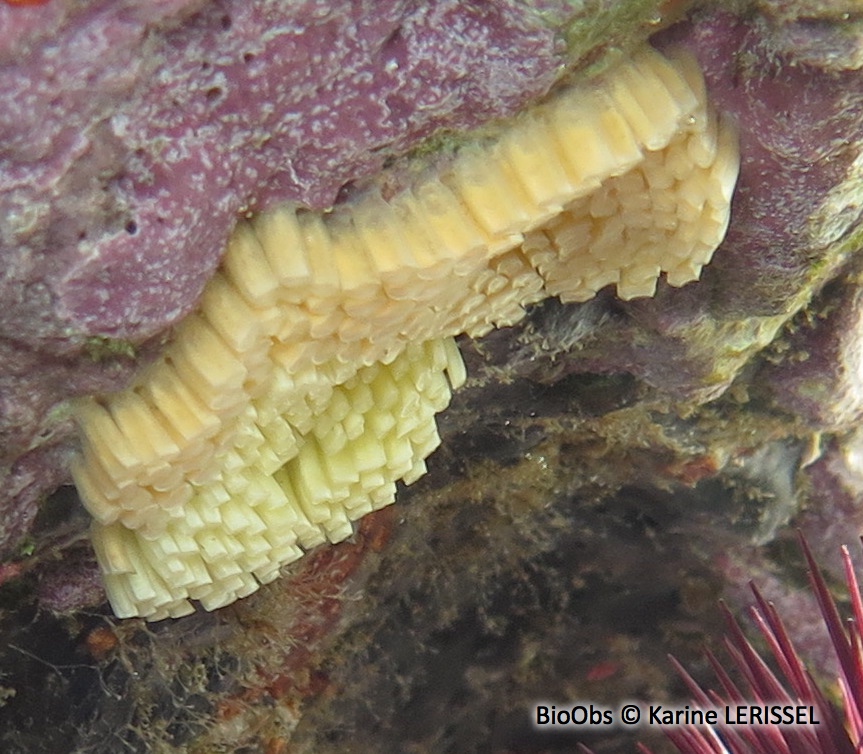
Bouche de sang ponte

Related to:

Bouche de sang ponte

Stramonita

Relation type:

Spawning

Separate sexes with internal fertilisation, in spring and summer. Females lay clusters of small yellow egg capsules, shaped like cones or vases, fixed to the rock.

Distribution map

Geographic areas (BioObs)

Western MediterraneanMediterranean - Alboran SeaEastern MediterraneanNorth-East AtlanticGuadeloupeMartiniqueCanary Islands

Observation type

Scuba divingApnea / SnorkellingForeshore / Shoreline

Other common names

  • Red-mouthed Dog WinkleBritish English
  • Red-mouthed rock shellBritish English
  • Florida dog winkleBritish English
  • Rotmund-LeistenschneckeGerman (Germany)
  • Rotmundige SteinschneckeGerman (Germany)
  • Rotmund-MaulbeereGerman (Germany)
  • PurpurschneckeGerman (Germany)
  • Ouarque (Pays basque)European Spanish
  • CarnadillaEuropean Spanish
  • Bouche de sangFrench (France)
  • PourpreFrench (France)
  • Pourpre bouche de sangFrench (France)
  • Ouarque (Pays basque)French (France)
  • Boccone di mareItalian (Italy)
  • Roodmond rotsslakDutch (Netherlands)
  • Caramujo-da-rocha-roxoEuropean Portuguese

Other invalid scientific names

  • Buccinum cingulatum Lamarck, 1816
  • Buccinum haemastoma Linnaeus, 1767
  • Haustrum striatum Perry, 1811
  • Murex consul Gmelin, 1791
  • Purpura barcinonensis Hidalgo, 1867
  • Purpura fasciata Dunker, 1857
  • Purpura gigantea Reeve, 1846
  • Purpura gigantea Calcara, 1840
  • Purpura haemastoma (Linnaeus, 1767)
  • Purpura haemastoma acuminata Settepassi, 1977
  • Purpura haemastoma bulbosa Settepassi, 1977
  • Purpura haemastoma elongata Settepassi, 1977
  • Purpura laevis Monterosato, 1878
  • Purpura lineata Kiener, 1835 ·
  • Purpura macrostoma Küster, 1860
  • Purpura nebulosa Conrad, 1867
  • Purpura nuttalli Conrad, 1837 ·
  • Purpura oceanica Locard, 1886
  • Purpura unifascialis Lamarck, 1816
  • Purpura viduata Küster, 1859
  • Sinusigera cancellata A. d'Orbigny, 1851
  • Stramonita haemastoma haemastoma (Linnaeus, 1767)
  • Thais (Stramonita) hidalgoi Coen, 1946
  • Thais grisea Röding, 1798
  • Thais haemastoma (Linnaeus, 1767)
  • Thais hidalgoi Coen, 1946
  • Thais metallica Röding, 1798
  • Thais stellata Röding, 1798

Links to our partners' sheets

INPN — Stramonita haemastomaGBIF — Stramonita haemastoma

Sources

How to cite this BioObs sheet?

BioObs, 16/10/2026 : Stramonita haemastoma (Linnaeus, 1767), https://bioobs.fr/en/species-sheets/316

Modification history

  • Modified by Claude Code on 11/10/2026

Contact the species-sheet team

Spotted an error, have a detail to add or a photo to suggest for this sheet? Write to us — the team will reply by email.

Photos or PDF (optional)