Biotope / Habitat
The species frequents a wide variety of soft or hard substrates, including sandy, gravelly, and rocky bottoms, as well as seagrass beds.
It colonizes the intertidal zone of the foreshore as well as subtidal floors down to depths exceeding one hundred meters.
It favors temperate and cold waters, tolerating poorly the excessively warm temperatures of southern seas.
Juveniles preferentially settle in tide pools and sheltered beaches, occupying small periwinkle shells.
Adults migrate toward deeper zones and generally utilize whelk shells to house their expanding bodies.
The feeding regime is detritivorous and opportunistic, with the animal feeding on animal carcasses, suspended organic particles, and live prey captured during its movements.
It is capable of filter feeding when sea currents bring sufficient nutrient particles.
Social behavior is marked by frequent agonistic interactions, including ritualized fights for the acquisition of empty gastropod shells.
Distribution
The species is widely distributed in the North Atlantic Ocean, the North Sea, and the English Channel.
Its southern distribution along the European coastline traditionally extends as far as northern Portugal.
Historical records reporting its presence in the Mediterranean Sea are now considered misidentifications or confusions with other local hermit crabs.
The overall distribution range is generally stable, although sensitive to thermal fluctuations at the southern boundary of its establishment.
Possible confusions
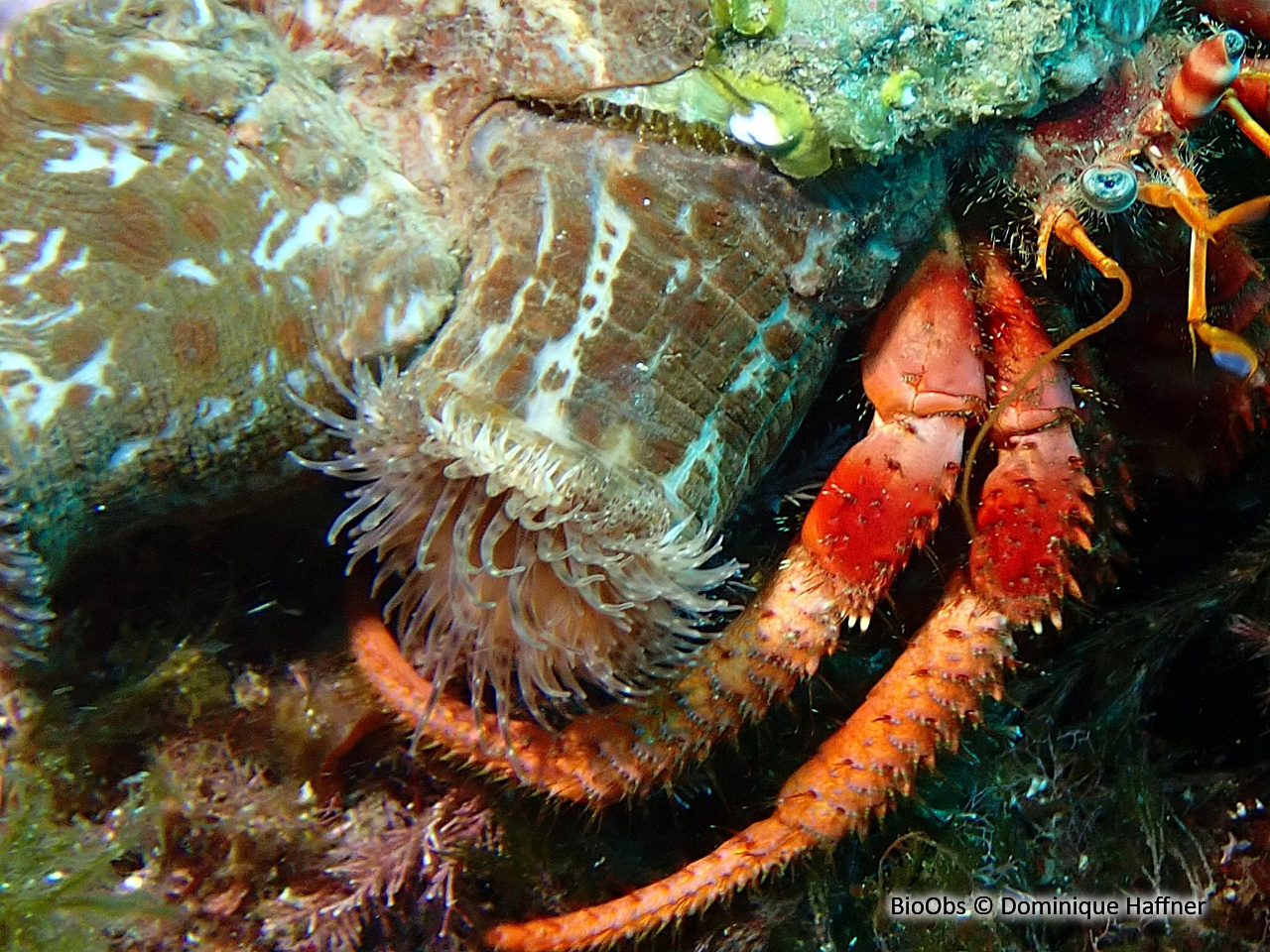
Pagurus prideauxi : possesses smoother claws with different proportions and lives almost exclusively in a symbiotic association with the cloak anemone Adamsia palliata, unlike the common hermit crab, which associates preferentially with Calliactis parasitica.
Anapagurus laevis : is distinguished by a markedly smaller size, a slenderer body, and smooth claws lacking the rough tubercles characteristic of P. bernhardus.
Clibanarius erythropus : a species restricted to rocky intertidal zones of the south and Atlantic coasts, recognizable by its equal claws of similar size and bright blue or red bands on the legs.